

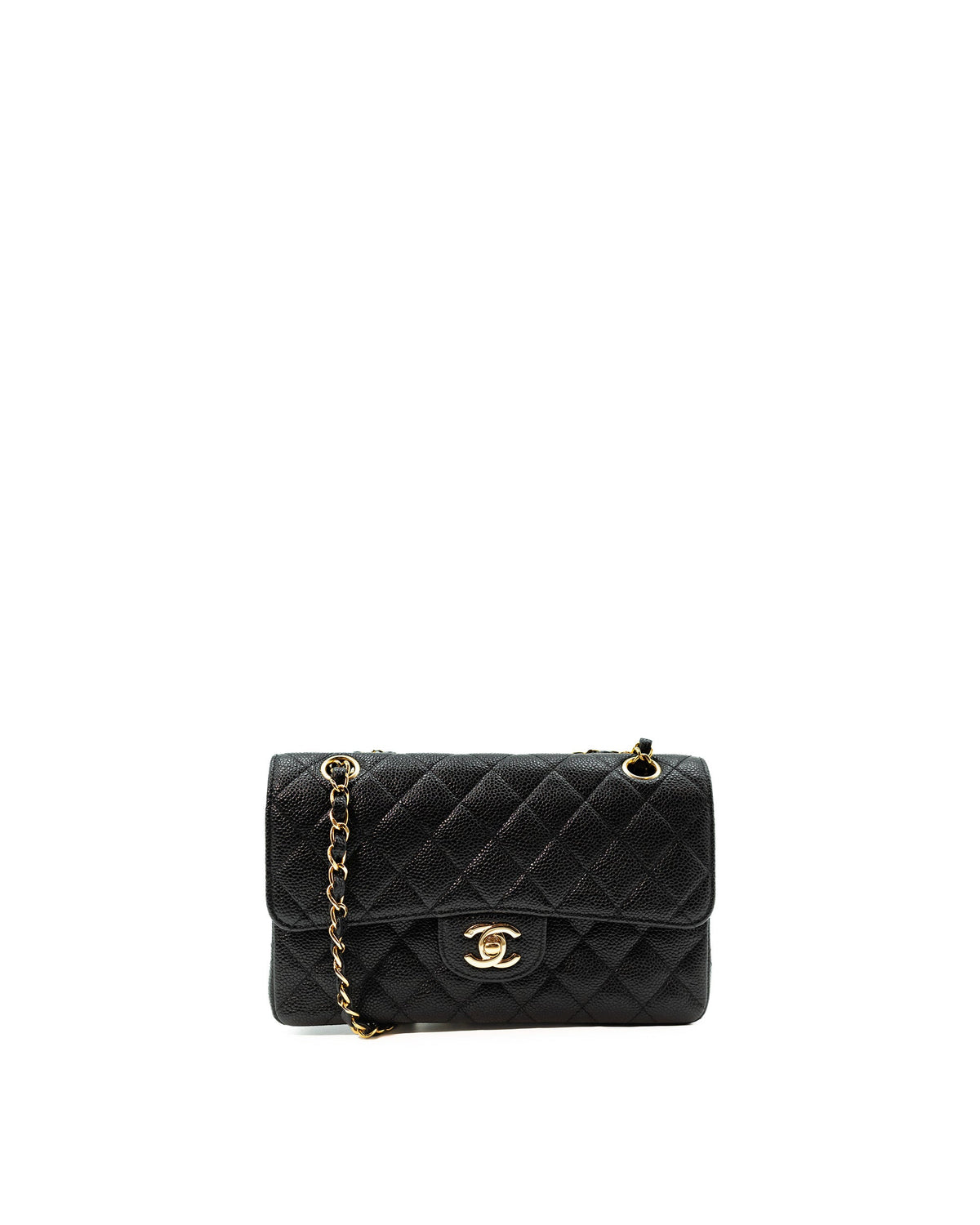
On a Chanel Classic Flap, the quilting and CC clasp are the most copied features and the first things people look at. L's interior tells you more: the lining, stamp, serial number, and clasp attachment require costly workmanship to imitate, and that's where counterfeits show inconsistencies. Below are the checks to make, using the Chanel Classic Flap Small in black caviar leather, currently available, as a concrete example.
Classic Flap, Timeless, and 2.55: which bag are we talking about?
In Italy, "Timeless" and "Classic Flap" refer to the same bag: a diamond-quilted flap, a turn-lock closure with two interlocking Cs, and a chain interwoven with leather. This is the version introduced by Karl Lagerfeld in the 1980s, also known by the reference 11.12. The 2.55 is the model it derives from, dating to February 1955, recognized by its rectangular Mademoiselle lock and all-metal chain. The internal checks are largely the same for both, but the production date of a reissue 2.55 and that of a Classic Flap must be read from the serial number, not the name.
The main sizes, by approximate width:
- Small: about 23 cm, double flap.
- Medium: about 25 cm, double flap. This is the 11.12 size in the strict sense.
- Jumbo: about 30 cm, made with both single- and double-flap designs.
- Maxi: about 33 cm, also available in both versions.
The stated size should always be compared with the actual size: a format that does not match any catalog size is already a sign to investigate further.
Inside a fake bag Chanel: the lining is the first clue
The Classic Flap is lined in leather, not fabric. On black versions, the lining is typically burgundy leather. A canvas, satin, or shiny faux-leather lining on a Classic Flap is inconsistent with the model. On the original leather, check three things: finished edges with no glue residue, interior stitching as even as the exterior stitching, and no creasing where the lining follows the fold of the flap.
On a piece that has been used for several years, the lining may show signs of wear, especially on the bottom and in the pockets. This is normal and should be described in the condition details. What should not change is the quality of the construction: a lining that comes away from the edges or has irregular stitching indicates an issue with the original construction, not wear.
The CHANEL stamp inside
Inside the bag is a heat stamp bearing the word CHANEL, the ® symbol, and the wording "Made in France" or "Made in Italy". Both are correct: Chanel produces in both countries, and the country of origin alone says nothing about authenticity.
What to look for:
- Letters of uniform thickness and regular spacing, with no letters touching.
- Stamp embossed into the leather, not printed on the surface.
- On metallic stamps, the color stays within the outlines of the letters, with no smudging.
- Stamp centered and parallel to the edges of the leather it is applied to.
Serial number, card, and microchip: consistency matters
Pieces produced up to 2021: sticker and card
Until 2021, every bag Chanel has a sticker with a serial number attached to the inner lining, accompanied by a card with the same number. Seven-digit serial numbers generally correspond to production from 1986 to 2004, while eight-digit numbers correspond to later production. The number on the card must be identical to the one on the sticker.
A card alone proves nothing: cards also circulate separately from bags. Likewise, a partially worn sticker is not in itself a negative sign, because the film wears down with use. A thorough inspection considers the serial number, production period, hardware, and materials together and checks that they tell the same story.
Pieces from 2021 onward: microchip
Since 2021, Chanel has replaced stickers and cards with an NFC microchip inserted in the bag. The chip is invisible and can only be read with a dedicated device. A bag presented as having been produced in 2022 or later that still has a serial-number sticker is inconsistent.
A real-world example
The available Small Classic Flap has serial number 10374597: eight digits, series 10. According to reference tables used in the industry, series 10 corresponds approximately to 2005 and 2006. The original card is included and shows the same number. The serial number is clearly stated in the product listing, along with the online authenticity certificate.
The CC clasp, viewed from the back
At the front, the two Cs follow a precise pattern: at the top, the right C crosses over the left; at the bottom, the left crosses over the right. The most useful check, however, is on the back. Inside the flap, the clasp plate is secured with screws, fitted flush and aligned. The plate should sit against the leather without gaps, and the clasp should turn smoothly without any play. Glued or riveted plates are not consistent with the model.
Quilting, chain, and back pocket
With the bag closed, the diamonds on the flap continue onto those on the body without any misalignment. The same applies to the back, where the exterior half-moon pocket opening should not interrupt the pattern: the lines continue above and below the opening. The stitches are tight and consistent in length along every side of each diamond.
The chain alternates metal links with a strip of woven leather. The leather should pass evenly through every link, with no spots where it twists or thins. The metal color is the same on the chain, clasp, and chain loops.
Caviar or lambskin: what’s the difference in use?
Caviar is embossed calfskin. It resists scratches, holds the shape of the corners, and stands up to everyday use. Lambskin is smooth and softer, but marks easily: the corners, flap edges, and areas that come into contact with the chain show wear more quickly.
For anyone considering a pre-owned piece, the difference is practical. With caviar, the stated condition remains consistent over time; with a lambskin bag, it’s worth carefully checking photos of the corners and flap edge, where wear tends to concentrate. Caviar that is too smooth or has an evenly printed grain, without the small irregularities of natural leather, is another point to check.
What professional authentication checks
Professional authentication is not based on a single detail. The main checks:
- Consistency between the serial number or microchip, production period, hardware, and materials.
- Font and depth of stamps and engravings, compared with references from the same period.
- Stitching: density, consistency, and stitch direction.
- Leather grain and lining material, also examined under magnification.
- Hardware construction: screws, plates, weight, and metal finish.
Authentication is included in the price of every bag from Aurea Luxury Lab, with a certificate and verification code published on the product page. An item that does not pass authentication is not put up for sale. For checks on other lines from the fashion house, see our guide to how to identify an authentic bag from Chanel by its serial number and microchip; our guide to how to tell if a bag is authentic explains the method used for all brands.
The Classic Flap Small available
The selected piece is a Classic Flap Small in black caviar leather with gold-tone hardware: double flap, turn-lock CC closure, chain interwoven with leather, wearable double-stranded on the shoulder or long crossbody. Measurements: 23 × 14 × 6 cm, Excellent condition. Included: original dust bag, Chanel card with matching serial number, certificate of authenticity. The reference boutique price listed on the product page is €10,100. See the other pieces from the fashion house in the Chanel collection.


Leave a comment
This site is protected by hCaptcha and the hCaptcha Privacy Policy and Terms of Service apply.