

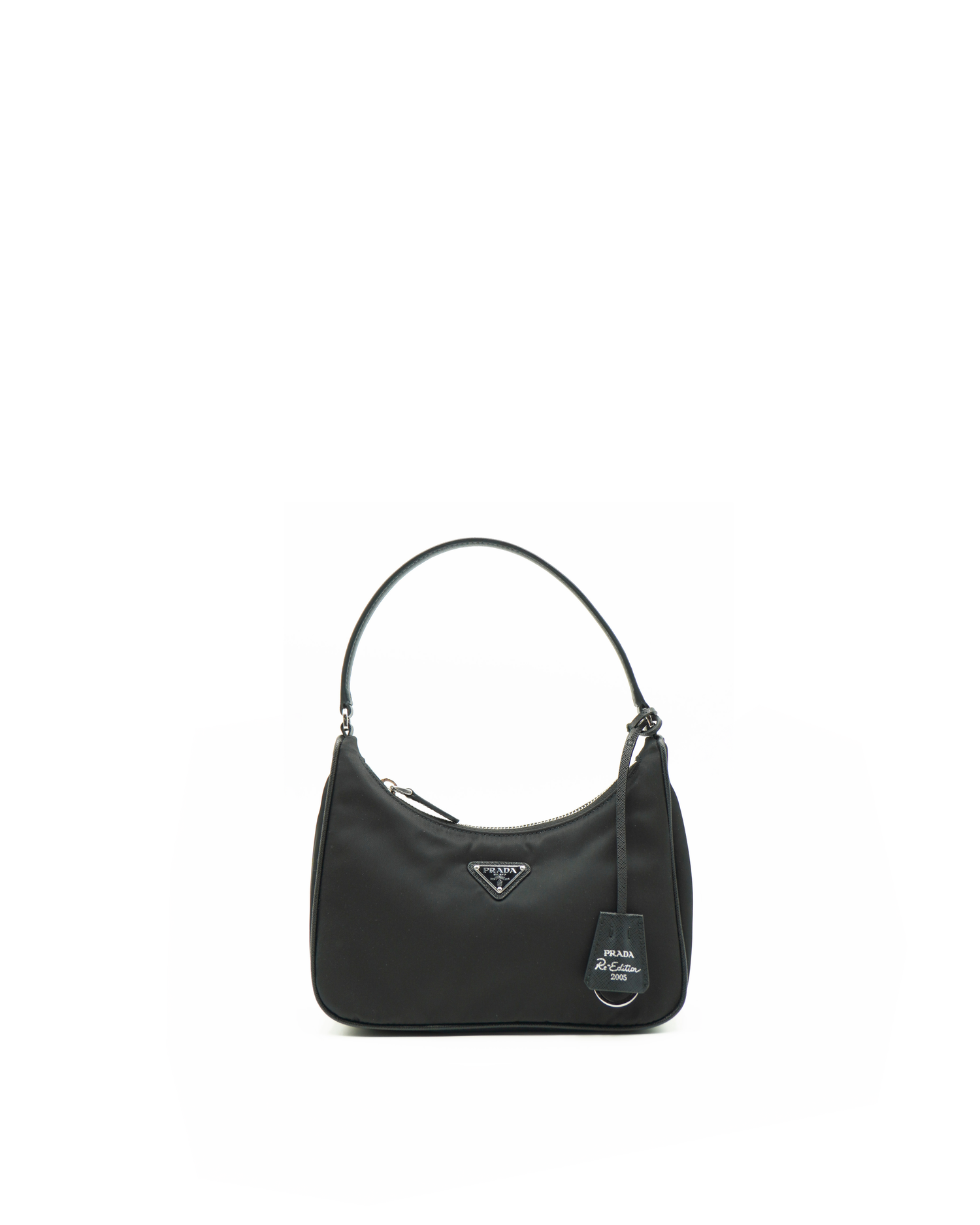
On a Prada bag, the metal triangle is the detail that counterfeiters most often get wrong. On the original, the plate is made of solid metal, applied with regular and symmetrical stitching, and the letters are sharply engraved, never printed or softly embossed. The most reliable sign is the R in "PRADA": the right leg of the letter extends outward with a small curve. This is a typographic detail that imitations almost always straighten or distort because replicating it precisely is costly.
The triangle and the logo: where to look
The triangular plate should be examined closely. On an authentic piece, the metal feels cold and heavy, the finish is uniform, and the letters have consistent spacing. On leather models, the plate is sewn or attached flush, without visible glue and without crooked stitches. On fabric models, the triangle is sewn along the perimeter with a row of tight, aligned stitches: irregular glue or stitching is a negative sign.
The circular logo that appears on tags and some linings bears the inscription "PRADA MILANO" with the house’s rope emblem and the indication "DAL 1913," the year of foundation in Milan. Here too, sharpness matters: the emblem’s outlines must be defined, not blurred. A smudged logo or one with approximate proportions is almost always a sign of reproduction.
The internal label and the code
Inside, an original Prada features the brand hot-stamped on a leather tab or a metal plate, with the same clean font as the external triangle, including the slanted R. Near the internal logo, or on a label sewn into the pocket, there is a factory code: an alphanumeric sequence identifying the model and craftsmanship. Many bags come with an authenticity tag bearing a matching number and, on more recent models, a branded protective pouch.
Another useful check is the lining. Many Prada models have a jacquard interior with the word "PRADA" repeated at regular intervals, woven into the material rather than printed on the surface: the letters remain sharp even when folding the fabric and maintain consistent spacing. Other models have nylon or matching leather linings, always carefully finished with clean stitching along the internal pockets. A lining with a faded, misaligned, or printed logo is a red flag.
However, be careful not to rely solely on the code or tag. These are the easiest elements to counterfeit because they are copied from real pieces. An original Prada label is evaluated together with the rest: font, quality of the leather it is stamped on, alignment of the stitching around the tab. If the label is perfect but the R is wrong, or the leather is stiff and plasticky, the code does not save the bag.
Saffiano, fabric, and Re-Nylon: the material test
Saffiano is the leather that made Prada recognizable: a calfskin treated with a crosshatch texture and a waxed finish that makes it scratch-resistant. On an original, the crosshatch pattern is regular and continuous across the entire surface, including corners and edges, and the color is uniform. Imitations often have an irregular texture that "breaks" at the seams or an overly pronounced and shiny embossing. A good reference for comparing craftsmanship is the Prada Galleria in Saffiano, the structured model that best showcases this texture.
On technical fabric models — the material that made the backpack and the Re-Edition 2005 in nylon famous, among the most sought-after pre-owned pieces — the nylon weave is dense, compact, and free of abnormal wrinkles. Recent Re-Editions use Re-Nylon, a regenerated nylon: the feel is soft but structured, never plasticky or waxed like some copies. The leather trims on handles and edges must be of the same quality as the body, not a cheaper substitute.
Zippers, hardware, and stitching
The hardware on an authentic Prada is heavy and well finished. The zippers glide smoothly without sticking and often have an engraving on the pull: on older models, high-quality suppliers like Lampo or Riri can be found, recognizable by the markings on the back of the pull tab. Feet, clasps, and rings are made of solid metal, with engraved logos rather than hot-stamped on painted plastic.
Finally, the stitching tells a lot. On an original, it is straight, with consistent stitch density and no loose or fraying threads. The stitches around the logo plate and handle attachments are symmetrical on both sides. Slanted stitching, variable spacing, or visible glue at the edges indicate workmanship that Prada would not allow to leave the factory.
Why the serial number alone is not enough
None of these checks, taken individually, is definitive. The best fakes copy the triangle or the code well; the cheapest get everything wrong. The correct reading is holistic: the R, label, material, hardware, and stitching must tell the same story. When even one of these elements clashes with the others, it’s best to stop, especially when buying a pre-owned Prada where there is no boutique to guarantee authenticity.
The only method that settles the matter is professional authentication, which combines an expert’s eye with instrumental analysis. This is the principle behind Entrupy certification, which microscopically analyzes materials and compares the piece with a reference database. Every bag we handle undergoes this verification before being put up for sale, using the same method we apply to other brands: it applies to Prada as well as to how to recognize an original Chanel.
If you are considering a purchase, always ask for close-up photos of the triangle, the internal label, and the stitching: these are the three shots that reveal the most. And if you prefer to skip doubts, you can start with our selection of pre-owned Prada bags, already authenticated and with conditions declared piece by piece.

Leave a comment
This site is protected by hCaptcha and the hCaptcha Privacy Policy and Terms of Service apply.