

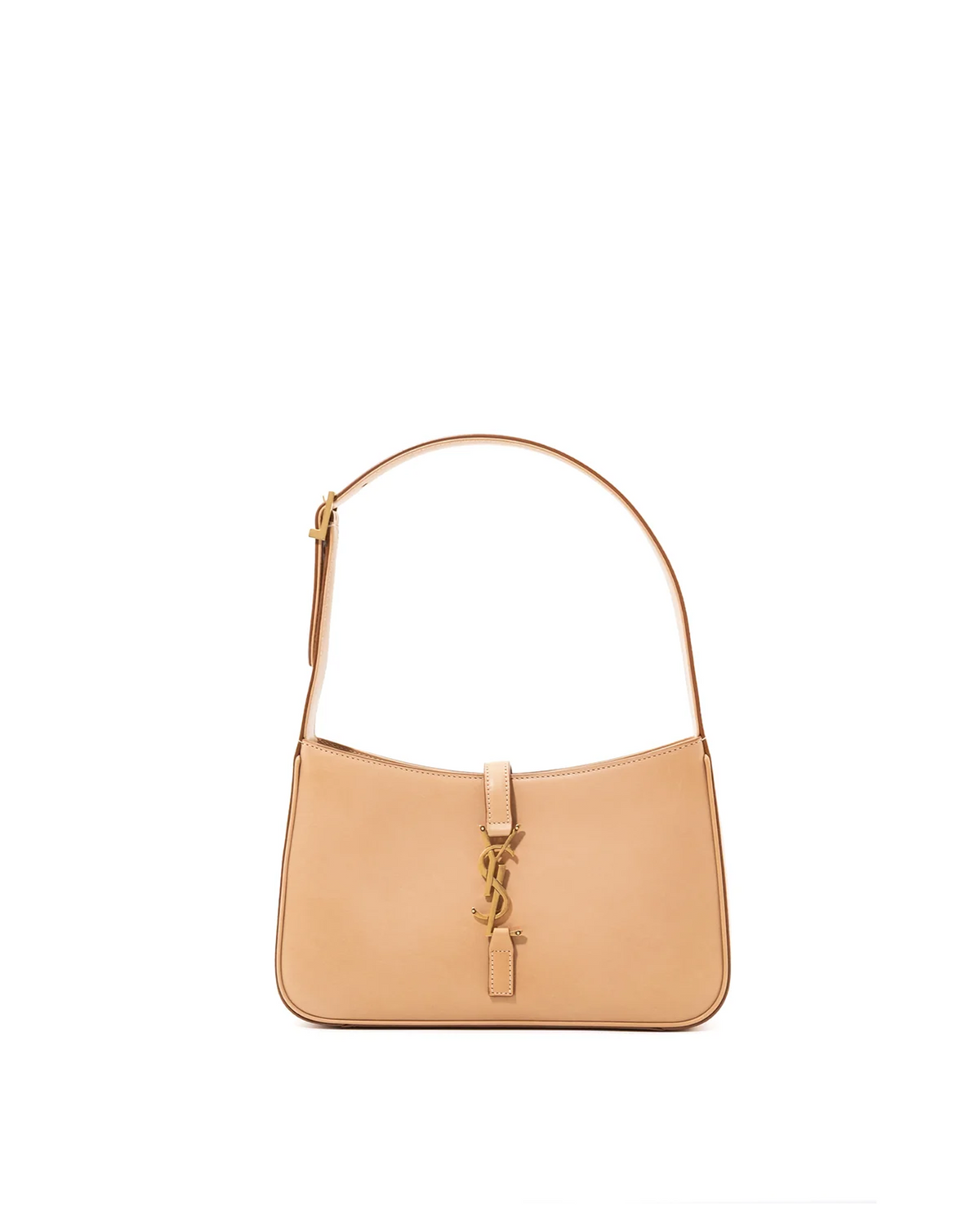
With Saint Laurent, the detail that gives away a counterfeit is almost never the same from one model to another: the Envelope is judged by its closure, the Rive Gauche by its canvas, and the Sulpice by its leather. People who search online for "original or fake Saint Laurent bag" often expect a single checklist that applies to the entire brand, but over the past fifteen years Saint Laurent has changed its name, hardware, and even the way it applies its logo several times: the right rules for one model are not enough for another.
The Cassandre signature, and where Saint Laurent really uses it
The YSL monogram was designed in 1961 by French graphic designer Cassandre and has since appeared on various models as an engraved metal plaque in the closure - not printed, not glued on in relief, but milled into the metal with sharp edges and a thickness that can be felt to the touch. On the Le 5 à 7 and the Sulpice, the gold logo is the first point to check: on an original piece, the metal has no burrs, the fastening screw is visible, and the gold plating does not turn yellow after a few months of use.
Not all models use it in the same way. On the Icare Maxi, the Cassandre is smaller and more discreet, integrated into the quilted flap; on the Envelope, however, the closure is a twist-lock YSL monogram, not the Cassandre plaque: confusing the two logos is the most common mistake made by people checking the wrong detail while expecting the same shape every time.
The interior stamp: from Yves Saint Laurent to Saint Laurent Paris
In 2012, when Hedi Slimane became creative director, the maison shortened its name to "Saint Laurent Paris", including on the interior leather stamp: bags produced before that date still bear "YVES SAINT LAURENT", while later ones bear only "SAINT LAURENT PARIS". It is a useful clue for dating a vintage piece, but on its own it does not certify authenticity: the stamp must be assessed together with the sharpness of the engraving, which should never be smudged or so deep that it cuts into the leather, and with its position, always centered in relation to the interior pocket.
Models without a plaque: the Rive Gauche case
The Rive Gauche, the écru canvas and black leather tote named after the boutique opened by Yves Saint Laurent in 1966, has no metal plaque: the logo is printed directly on the canvas, so the inspection focuses on the fabric weave, which should be dense and regular, never frayed at the edges, and on the leather reinforcements hand-stitched along the handles with visible, even stitches. It is the clearest example of how risky it is to apply a checklist designed for one model to another.
Measurements, leather, and hardware: details a photo does not show
Photos in an online listing can conceal almost everything except measurements: the Envelope Small, for example, measures 21 x 13 x 6 cm in the version with a shoulder strap, a precise proportion that a counterfeit made from a generic mold rarely matches to the centimeter. The same applies to the weight of the hardware: buckles and rings are made of solid metal, not plastic with a plated coating, and feel heavier than expected when looking at the photos. The leather varies from model to model - pebbled on the Envelope Large, smooth calfskin on the Le 5 à 7, quilted lambskin on the Icare Maxi - and none of these textures should look uniform, plasticky, or devoid of natural grain.
The price, a clue but not proof
On the certified pre-owned market, prices for a Saint Laurent in good condition vary considerably depending on the model: from just over 1,100 euros for a canvas Rive Gauche to more than 3,500 euros for a lambskin Icare Maxi, with the Envelope, Le 5 à 7, and Sulpice in the mid-range, between 1,200 and 1,800 euros. A price far below these reference points is not enough on its own to say that a bag is fake, but it is an additional reason to insist on the checks described above before paying.
What to ask before buying online
Before finalizing a purchase, it is worth asking the seller for a few specific photos, which are more useful than the polished images often used in listings:
- A close-up of the interior stamp, legible and in focus, not cropped or blurred.
- A photo of the closure, Cassandre plaque, or twist-lock monogram, taken from a side angle to check its thickness.
- Photos of the stitching along the handles and at the corners, where wear and assembly quality show first.
- The model's exact measurements, which can be compared with those provided by a retailer that lists them on the product page.
A seller who cannot or will not provide these details is already giving you an indication, regardless of the asking price.
Why a discontinued model requires more attention
The Sulpice, introduced in 2018 during the Vaccarello era and now discontinued, is a special case: discontinued models can no longer be directly compared in boutiques, so anyone who wants to verify them must rely on third-party sources or retailers that carry out an independent inspection before sale. This is why at Aurea every piece, including those that left the official catalog long ago, is authenticated individually before being listed for sale, using the same process described in our guide to the Entrupy certificate.
Anyone buying a second-hand Saint Laurent is right to always ask for close-up photos of the interior stamp and the closure before deciding: these are the two areas that a counterfeit struggles to reproduce without visible errors, whatever the model.

Leave a comment
This site is protected by hCaptcha and the hCaptcha Privacy Policy and Terms of Service apply.