


The fastest way to be deceived by a Fendi Baguette or Peekaboo is not buying from an unknown channel, but trusting a single detail — the FF logo, the box, the seller’s word — and ignoring the others. A well-made counterfeit today reproduces almost everything except one or two points. Those are precisely the ones to check first, in the right order.
The FF motif: it is not a logo, it is a weave
The double F was created in 1965, when Karl Lagerfeld became Fendi’s creative director and designed the monogram that would become known as Zucca or Zucchino. On an original piece, the two Fs are mirrored and sewn (or jacquard-woven) into the fabric’s weave, not printed onto smooth cotton: the motif runs through the fabric, so it looks identical even when the item is turned over and viewed from the back.
Three practical checks on Zucca fabric:
- The Fs are perfectly symmetrical and repeated at a constant distance; on a counterfeit, one is often slightly larger or lighter than the other.
- At the seams, the design matches from one panel to the next: the original manufacturer deliberately aligns the motif, while those who copy it rarely do.
- The color is a warm ochre on a brown background, never a flat black or a cool brown: these are the shades also seen on the Zucca FF canvas shopper currently available from Aurea.
The internal serial number and where to really look for it
Fendi sews in an internal tag or label with an alphanumeric code, almost always in an inner side pocket or beneath the lining flap, never visible from the front. On an original piece, the engraving or printing is sharp and even, with no glue smudges around the edge, and the tag is sewn to the lining, not simply glued or attached with a plastic loop. If the code is printed crookedly, blurred, or on a tag that comes off with a flick of a fingernail, that is already enough of a warning sign to stop.
Selleria: the stitching a counterfeit cannot replicate
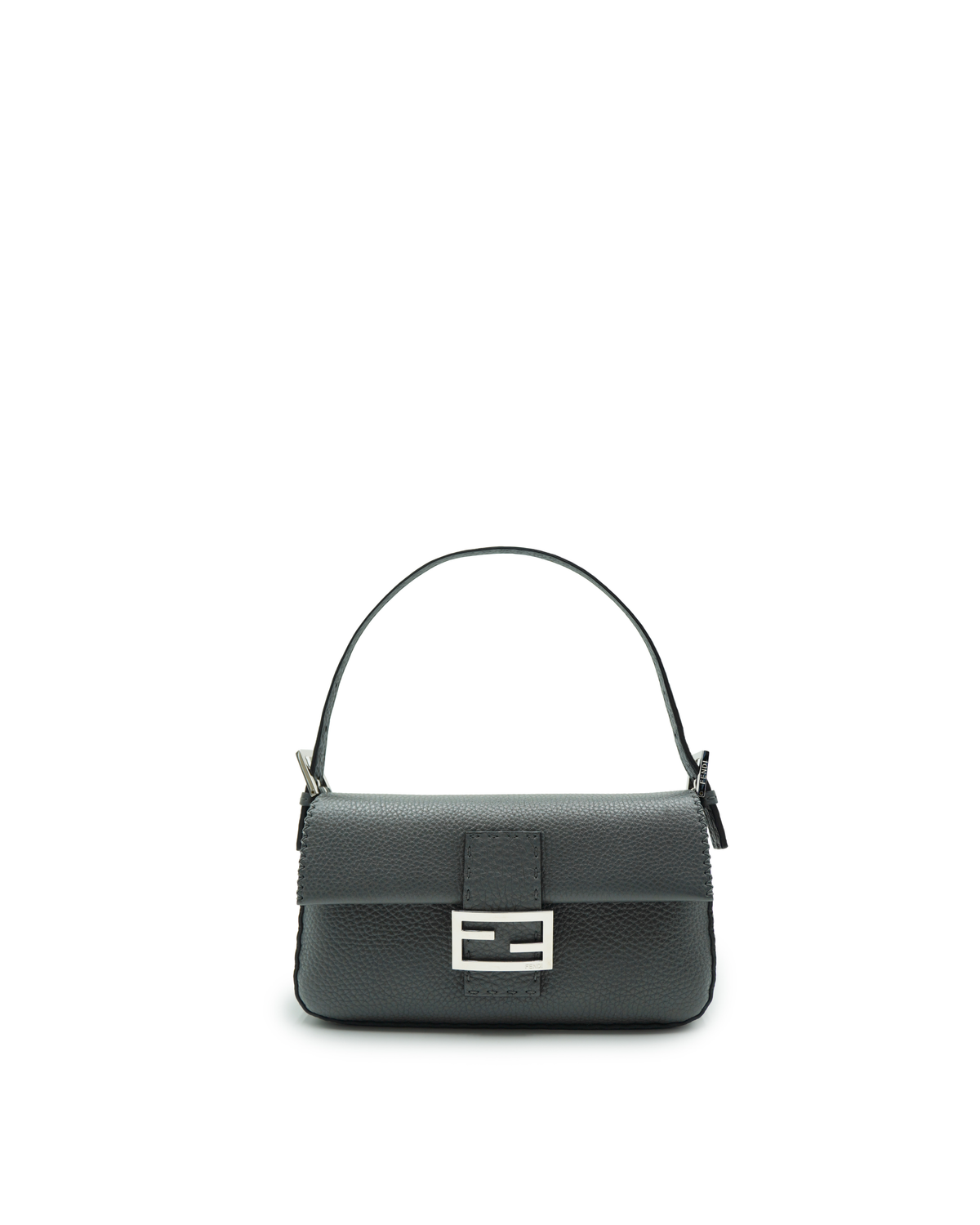
“Selleria” refers to the Fendi line made using saddlery technique: entirely hand-stitched, with thick waxed thread, visible saddle stitching that is identical on both sides of the leather. It is not a decorative detail: on a Peekaboo ISeeU in Cuoio Romano from the Selleria collection currently in stock, the craftsmanship requires more than 300 hand stitches on a single item. That amount of manual work cannot be replicated by an industrial production line within the time and cost constraints of a counterfeit.
What to look at closely:
- The stitch is large, even, and slightly raised; on a counterfeit, it is almost always machine stitching, smaller and unnaturally uniform.
- The thread is matte and waxed, not shiny or synthetic.
- The spacing between stitches remains consistent along the entire profile of the bag, including the corners.
These details are easy to check on models such as the Fendi Baguette Selleria in hammered leather, where the visible stitching runs along the entire perimeter of the flap.
Why Baguette and Peekaboo are the most copied
The Baguette was created in 1997, designed by Silvia Venturini Fendi to be carried under the arm “like a baguette,” hence the name. Its fame exploded thanks to Sex and the City, where Carrie Bradshaw carried it for an entire season: from there, it became a status symbol that counterfeiters still pursue today, almost thirty years later. Peekaboo, with its rigid double-compartment structure and padlock closure, has taken on the same role over the past decade: the longer a model remains desirable, the more imitations enter circulation, including those sold as “pre-owned” to justify minor imperfections.
Hardware and leather: what you can feel to the touch
On original hardware, the Fendi logo or double F is engraved sharply and deeply, never stamped with a shallow raised finish or applied like a metallic sticker. The metal is heavy and cold to the touch, with no sharp edges or casting blemishes. Zippers glide effortlessly, and the pulls often bear a legible mark.
Whether it is Cuoio Romano or hammered leather, the surface should not have a chemical smell of solvent or paint: this is a common clue, although by itself it is not enough to certify anything. The edges are cut cleanly and finished with wax or hand-applied dye, with no excess glue visibly running along the profiles.
The price is the first warning sign, not the last
Authentic pre-owned Baguette or Peekaboo Selleria bags remain within a recognizable price range: the certified pieces listed by Aurea, such as the Fendi Peekaboo ISeeU Limited Edition or the Baguette Cuoio Romano Petrol, range from €1,900 to €2,700. A drastically lower price does not automatically mean counterfeit, but it is the first warning sign that deserves independent verification before any other aesthetic check.
For every bag we purchase, verification combines examination of the details described above with a third-party check — the same process described in our article on the Entrupy certificate, which we also explain to anyone who wants to understand how serious authentication works before selling or buying pre-owned.
What to do if you already have a bag and have doubts
The checks above — serial number, Selleria stitching, FF motif, and hardware — require having the bag in hand: a photo or an online description is not enough for a definitive diagnosis, especially with complex models such as Baguette and Peekaboo, whose versions have multiplied over time. If a detail still does not add up after these checks, the safest choice remains professional authentication before proceeding.

Leave a comment
This site is protected by hCaptcha and the hCaptcha Privacy Policy and Terms of Service apply.