


On Fendi bags, counterfeiting almost always focuses on the surfaces: the FF motif, the logo on the flap, and the silhouette of the Baguette. Almost never on the construction. That is where you find differences observable without tools, and that is where it is best to look before spending four figures on a pre-owned bag.
Zucca canvas is woven, not printed
The double F arrived in 1965, when Karl Lagerfeld joined the Roman maison founded in 1925 by Adele and Edoardo Fendi. On Zucca canvas, the motif is created through weaving: the design is part of the fabric, not applied on top.
Three practical consequences follow. The reverse of the canvas shows the motif in negative, not a smooth backing. Running a fingernail over the F reveals no raised ink. And at the seams, the motif stops and resumes with a coherent alignment between the two panels, because the canvas is cut according to the pattern repeat. On replicas, the surface is continuous but misaligned at the edges, and the thickness of the F changes at points of greater curvature.
A second clue concerns weight. On the brown canvas Zucca FF shopper (33 × 28 × 8 cm), the interior is unlined: the canvas is visible from inside, and the bag remains extremely light even when fully loaded. Copies almost always add a synthetic lining to stiffen the shape, and the empty weight increases noticeably.
Selleria: the stitching is the evidence
The Selleria line applies saddle stitching to leather goods: two needles work through the same hole from opposite sides, using thick thread, by hand. This produces two characteristics that a machine cannot reproduce.
The stitching looks identical on both sides
On the front and reverse of the leather piece, each stitch has the same angle and length. Because of how the hook mechanism works, machine stitching leaves a different pattern on the reverse from the front. This is the most difficult detail to falsify and the quickest to check: simply open the bag and look at the same seam from inside.
The regularity is high but not perfect
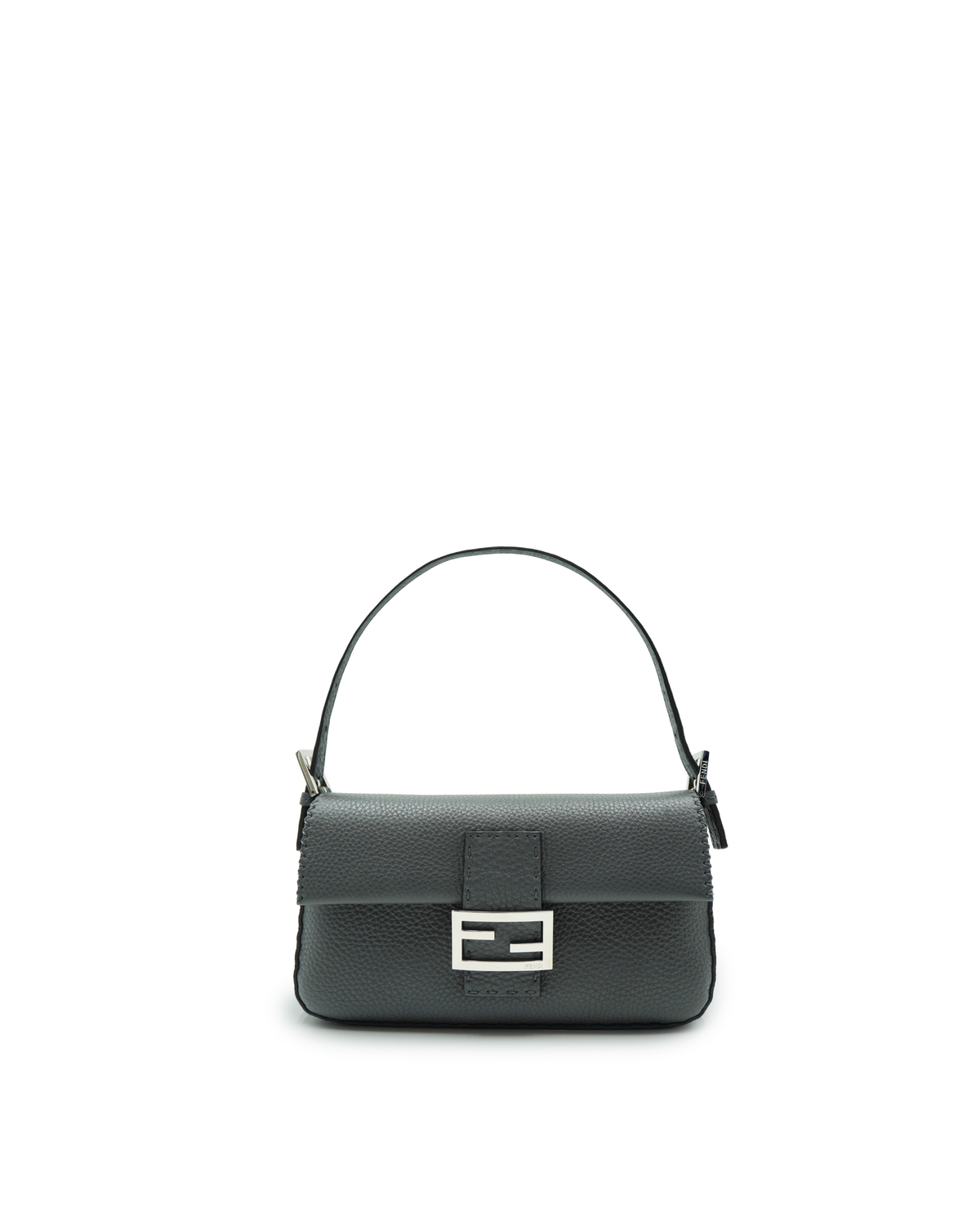
On the Limited Edition Selleria Baguette in hammered leather, there are 612 tone-on-tone decorative stitches. They are large, spaced apart, and intentionally prominent: when viewed closely, the angle varies by fractions of a millimeter from stitch to stitch, and the thread always enters the same hole without skipping. By contrast, decorative machine stitching on a copy is millimetrically identical along its entire length, and at changes of direction it tends to overlap two stitches.
Roman leather is not smooth
Selleria leather is metal-free-tanned calfskin, with visible, uneven natural grain: pores, slight tonal variations, and a pattern that changes from one panel to another. The pre-owned petrol Roman leather Baguette clearly shows this behavior in dark colors, where embossed printed leather would instead appear repetitive at regular intervals.
Bags from the Selleria line also carry individual numbering. If it is completely missing, or appears printed on a removable sticker rather than embossed, it is something to clarify before purchasing.
The interior code must be compared with the model
Inside, most Fendi bags have a leather tab or area bearing the brand name, an indication of Italian manufacture, and an alphanumeric code. The code cannot by itself establish whether a bag is genuine or fake: it serves to verify consistency. It must correspond to the model and variant being examined, not to another reference in the catalog.
On this area, check three things: the depth of the impression, which should be uniform across all characters; the spacing between letters, which should be consistent; and the absence of dark halos around the characters, typical of poorly executed hot stamping. An exact code on an irregular stamping is worth less than an illegible code on a clean stamping: numbers can be copied, workmanship cannot.
Peekaboo: the twist lock and central divider
The Peekaboo was created in 2008 by Silvia Venturini Fendi, the same designer behind the 1997 Baguette. Its mechanism is the key point to check: the bag opens by allowing the sides to fall outward, revealing two compartments separated by a rigid divider.
That divider must be sewn along the entire base and sides, not glued: running a finger along the edge, you can feel the stitching. The twist lock should turn with clear resistance and stop in position, without lateral play. On copies, the divider is often just a glued panel that comes loose at the sides with use, and the closure turns softly and continuously.
On the Peekaboo ISeeU Limited Edition, the graphic decoration provides an additional check: the edges of the design should remain sharp even where the leather bends, because they are made on the leather rather than on an applied film.
What proves nothing
Dust bags, tags, keychains, and boxes are easy to reproduce and circulate separately from the bags: they are sold online on their own. Even a boutique receipt does not certify the contents of the box. For the same reason, the interior code alone, read without examining the workmanship, is not proof.
A reliable verification combines physical examination with an independent check. Every piece we handle is delivered with an Entrupy certificate of authenticity or LegitGrails, depending on the brand and model: it is the same approach applied to other brands, as in the checks described for identifying an authentic Gucci bag.
For pre-owned bags, after authenticity
Once provenance has been verified, two points remain that affect the price more than you might think. The first is the bottom corners: on Baguette and Peekaboo bags, these are the points of contact and show wear before anything else. Ask for a close-up photo of all four corners and the base, not just the front view.
The second is the strength of the magnetic closure on the Baguette. With use, the magnet loses strength and the flap remains slightly open: this is a defect that cannot be seen in a photograph and affects everyday use. Specifically ask whether the flap closes and stays secure when the bag is full.
On a discontinued piece, these two details alone can explain differences of hundreds of euros between two seemingly identical examples.

Leave a comment
This site is protected by hCaptcha and the hCaptcha Privacy Policy and Terms of Service apply.