

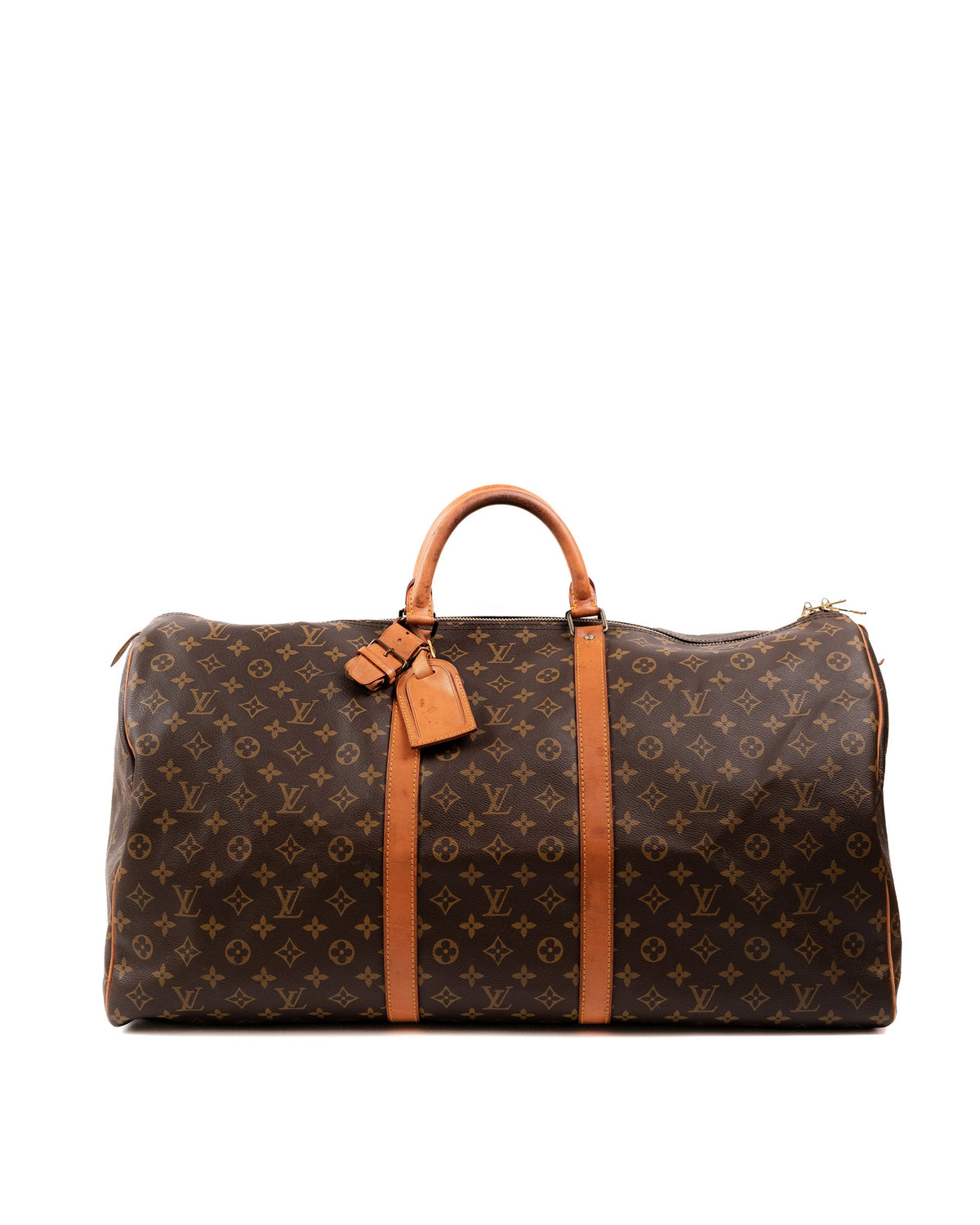
A thirty-year-old Louis Vuitton should not look new. Much advice on recognizing an authentic vintage bag is written with recent models in mind: applied to a vintage piece, it can reject genuine originals and, worse, allow deliberately aged fakes to pass as authentic. With a vintage bag, the right question is not "is it perfect?" but "is the wear I see what this material actually produces?"
What is normal on an authentic vintage Louis Vuitton bag
Vachetta darkens in patches, not uniformly
Vachetta is the untreated natural leather used for handles, tabs, and edges. With light and contact, it changes from pale to honey-colored, but it does so where the bag is touched: handles and attachment points darken first, while areas covered by a tab or stitching remain lighter. Identical patina across the entire surface, without gradients, is more suspicious than stained vachetta. Water drops leave permanent dark marks: this is a defect to disclose, not proof of a fake.
Coated canvas can deteriorate over time
Monogram canvas is canvas with a coating. On pieces stored for long periods in damp or enclosed environments, the coating can become sticky to the touch or flake along the edges. This is age-related deterioration: it should be assessed and recorded in the condition, but it does not indicate that the bag is fake. It indicates that storage history matters as much as the year of production.
Gold-tone hardware wears down, revealing the metal underneath
On heavily used zippers and rings, the gold plating becomes thinner and reveals the yellow metal underneath, especially at points of friction. Be wary instead of plating that comes off in flakes, leaving a gray or silver-colored base, and of hardware that is too light for the size of the bag.
Anachronisms: details that cannot exist
On vintage pieces, the most reliable check is consistency between the material, model, and stated year. Some fixed points:
- Epi leather, with its wave-like grain, dates from 1985. An Epi bag presented as "from the 1970s" is inherently inconsistent.
- Date codes began appearing in the 1980s. No code should be sought on an older piece, and its absence is not a warning sign. We explain how to read the formats before and after 2007 in the Louis Vuitton date code guide.
- From around 2021, the code was replaced by a microchip: a bag described as "vintage" that contains one is not vintage.
- A "made in" country other than France is not suspicious in itself: Louis Vuitton also produced items in Spain and the United States. What matters is that the country and the code, when present, point to the same era.
An anachronism exposes a fake faster than any stitching detail. The reverse is not true: a consistent era is not enough to declare a bag authentic.
Three models, three different checks
Every material ages in its own way, so there is no single test. Here is what to look for on three vintage models currently in our catalog.
Keepall 55: the patina and measurements
The Keepall was introduced in 1930 as a lightweight alternative to travel trunks. The number in the name indicates the length in centimeters: the Keepall 55 in Monogram canvas measures 55 × 31 × 26 cm, with double handles and a zip closure. Check with a tape measure that the dimensions match the stated size: a difference of several centimeters is a warning sign. Here, the vachetta is the evidence: handles darkened by use, lighter attachment points, and edges with the same tone around the entire perimeter.
Sac Plat: the shape must hold up empty and full
The Sac Plat in Monogram canvas was introduced in 1968 as a carryall: empty, it folds flat; full, it becomes an upright bag. The version we carry measures 35 × 38 × 9 cm, with double vachetta handles, an open top without a closure, and an interior flat pocket. Check all three measurements with a tape measure: the depth of just 9 cm is part of the model. Versions with zippers exist, so always compare the bag with the technical specifications of the stated version, not with a generic image of the model.
Jasmin in Epi: vachetta is irrelevant here
The patina test does not apply to Epi leather, because the material is calfskin with a wave-like grain, resistant to scratches and water, that does not darken like vachetta. On the black Epi Jasmin, measuring 32 × 18 × 9 cm and made in France, the focus shifts to the grain: regular waves with uniform depth across the entire surface. The Jasmin is no longer in production, so an advertisement presenting it as a new boutique model is inconsistent.
How much is it worth, and what does a price that is too low mean?
According to our listings, the average pre-owned market price in comparable condition is approximately 1,150 euros for the Keepall 55, 880 euros for the Sac Plat, and 850 euros for the black Epi Jasmin. These are rough ranges, not price lists: condition and included accessories affect the value. A Keepall 55 priced at 250 euros is not a bargain: it is an anomaly that needs explaining.
What to ask before buying
Ask for close-up photos of the vachetta, hardware, and edges, a precise indication of the era, and the date code, if there is one. Ask how the bag was stored: sticky or flaking canvas says more than a label. For a purchase over 800 euros, no visual inspection is sufficient on its own: every piece we deliver comes with an Entrupy or LegitGrails certificate, depending on the model, and we explain what the Entrupy certificate does. In the Louis Vuitton pre-owned collection, you can find the available pieces, already verified.


Leave a comment
This site is protected by hCaptcha and the hCaptcha Privacy Policy and Terms of Service apply.